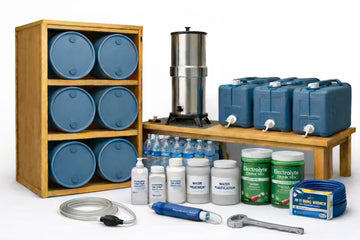
Water
Water
If Water Is Not Already Inside Your Home, It Is Not Part Of Your Plan.
Food can be stretched. Water cannot.
Once water becomes uncertain, the whole household is under pressure fast.
A real water plan is more than a filter. It is stored volume, safe placement, manual transfer, daily control, cold-weather protection, and quiet indoor use.
Stored supply. Daily access. Protected storage. Indoor-only operation.
The First Rule Of Water Preparedness
Most preparedness advice starts with filters. That is backwards.
Stored volume comes first. Filtration only matters once water already exists inside the home.
Your water system has one job: keep your household drinking, functioning, and inside the home without depending on municipal pressure, electricity, or outside access.
If electricity fails, municipal pumping, pressure, and treatment can no longer be assumed. If a private well depends on power, it may not be available unless your backup system is already planned.
If you have to leave the house looking for water, your plan is already breaking down.
How This Water System Works
This system is designed to work quietly indoors with as little electricity as possible.
Store
Bulk water stays sealed, labelled, protected from light, protected from freezing, and placed where the structure can handle the weight.
Transfer
Water moves from bulk storage into smaller daily-use containers using a manual pump, siphon, or food-grade hose.
Filter
Gravity filtration produces controlled daily drinking water without power, noise, or outside movement.
Rule: bulk supply is not daily supply. Bulk stays sealed. Daily water moves in controlled steps.
Daily Water Target
Minimum baseline: plan around at least 3.8 litres / 1 gallon per person per day.
A more practical planning range is 3.8–5.7 litres / 1.0–1.5 gallons per person per day.
Simple planning number: use 4.7 litres / 1.25 gallons per person per day.
This covers drinking, freeze-dried meal rehydration, basic food preparation, minimal hygiene, and essential medication use.
Freeze-dried food does not reduce your water needs. It increases them.
Heat, illness, physical exertion, medications, pets, and poor indoor conditions can push demand higher.
30 / 60 / 90 Day Water Planning
This is the part most people underestimate. A few cases of bottled water are not a long-term water plan.
Formula: People × 4.7 litres × number of days = total litres required.
Imperial: People × 1.25 gallons × number of days = total gallons required.
| Household Size | 30 Days | 60 Days | 90 Days |
|---|---|---|---|
| 1 person | 142 L / 37.5 gal | 284 L / 75 gal | 426 L / 112.5 gal |
| 2 people | 284 L / 75 gal | 568 L / 150 gal | 852 L / 225 gal |
| 4 people | 568 L / 150 gal | 1,136 L / 300 gal | 1,703 L / 450 gal |
| 6 people | 852 L / 225 gal | 1,703 L / 450 gal | 2,555 L / 675 gal |
Reality check: 90 days of water is heavy, bulky, and difficult to improvise after a disruption starts.
Bulk Storage
Water must already be inside the structure before you need it.
Acceptable bulk storage includes 208 L / 55-gallon food-grade water barrels, 19–26 L / 5–7 gallon stackable containers, sealed water bricks, and large indoor water tanks.
Store indoors where possible. Elevate off concrete. Protect from sunlight. Seal and label with fill dates. Place water where the structure can handle the weight.
Drum shortcut: two people for 90 days need about 852 L / 225 gallons, roughly five 208 L / 55-gallon drums.
Four people for 90 days need about 1,703 L / 450 gallons, roughly nine drums.
Weight reality: one full 208 L / 55-gallon drum weighs about 208 kg / 460 lb. Plan placement before filling.
Placement reality: water storage is not just a supply issue. It is a structural issue. Smaller containers can fit in many homes, but multiple full drums belong on a basement floor, garage slab, utility area, or another safe load-bearing location.
Do not place water barrels directly on concrete. Use wood, foam, or pallets.
Cold-Climate Storage
In colder climates, stored water must be protected from freezing. This matters most when drums or tanks are kept in a garage, unheated basement area, utility space, shed, or cold corner of the home.
If water freezes, containers can split, caps can fail, pumps can crack, and the water may become difficult or impossible to access when you need it most.
Best setup: store bulk water where the structure can handle the weight, then protect it with an insulated enclosure if the area may drop below freezing.
A simple insulated plywood box can help protect bulk water from cold air while keeping the storage area organized and controlled.
- build the enclosure large enough for barrels, access, pump use, and inspection
- use rigid foam insulation inside the plywood box where appropriate
- keep containers elevated off concrete
- leave enough access to inspect caps, bungs, leaks, and fill dates
- do not permanently hide containers where leaks cannot be seen
- keep a smaller daily-use supply inside the heated living area
Cold-weather rule: bulk water can be stored in a colder location only if it is protected, accessible, and regularly checked.
If electricity is available from grid power, a properly sized solar backup system, or another safe power source, a small electric heater may be used for limited periods to protect an insulated storage area from freezing.
Use only electric heat designed for the location, keep clearance around the heater, avoid extension-cord overloads, protect cords from water, and never use open-flame or fuel-burning heaters inside an enclosed water box.
The goal is freeze protection, not comfort heating. Warm the storage space only enough to keep water liquid and equipment usable.
Rotation: rotate water every 12 months, sanitize containers before refilling, label fill dates, and inspect for leaks, bulging, cracks, damaged caps, freezing damage, or odour.
Stored water inside the home changes everything. No visible water runs. No hauling containers in public. No stepping outside looking for one of the most urgent supplies of all.
Example bulk storage options:
Note: The items shown below are example products only. They are provided to help illustrate the type of equipment that may be used as part of a preparedness plan. Equivalent products may also be suitable. Some links may be affiliate links and may support the site at no extra cost to you.
 |
 |
 |
Example sanitizing, preserving, and bottled-water support:
 |
 |
 |
Smaller Containers Are Useful — But They Are Not The Whole Plan
Smaller 19–26 L / 5–7 gallon containers are excellent for moving, staging, filtering, and daily use.
They are easier to carry than a drum and more practical inside the living area.
Simple reality: a 26 L / 7-gallon jug is useful. Dozens of them become clutter fast.
Best setup: bulk storage stays sealed and protected. Smaller containers do the daily work.
Transfer & Handling
Bulk barrels should remain sealed until water is needed. When water is needed, move only a small amount into a daily-use container and reseal the barrel immediately.
Use a manual drum pump, manual siphon pump, or food-grade transfer hose.
Access should come from the top opening. No bottom spigots should be installed.
Bottom spigots create leak points. Threaded fittings degrade. A failed seal can drain your supply.
Example transfer tools:
 |
 |
 |
Daily rhythm: move only one or two days of water at a time.
One person needs about 4.7 L / 1.25 gal per day. Two people need about 9.5 L / 2.5 gal per day. Four people need about 19 L / 5 gal per day.
Track every refill. The danger is not only running out of water. The danger is using it casually and discovering too late that the math no longer works.
- store barrels on wood, foam, or pallets
- if storing on their side, keep the bung at the highest point
- store pumps in a sealed plastic bag when not in use
- do not leave pumps installed permanently
- label transfer containers RAW WATER
- label filtered water separately
Keep bulk sealed. Move water in stages. Filter last.
Drinking Water Filtration
Stored water is your foundation. Filtration makes it usable as a clean daily supply.
A gravity filter works during power outages and keeps the system quiet, simple, and indoor-only.
Your gravity filter is not your bulk storage. It is the final step between stored supply and drinking use.
Filter capacity matters. For a household, the filter should process at least one full day of drinking and cooking water without becoming a bottleneck.
Spare parts matter too. Keep spare filters, washers, plugs, cleaning tools, and a backup way to treat water if the main filter fails.
Example daily transfer and filtration options:
 |
 |
 |
Daily Use Strategy
Keep one smaller daily-use container ready at all times. This is the water the household actually reaches for during the day.
That keeps your bulk storage protected, reduces contamination, and makes consumption easier to track.
- set the day’s water amount each morning
- keep drinking water separate from utility water
- do not use stored drinking water for toilet flushing
- use sanitation supplies instead of wasting water on drains and toilets
- use no-rinse hygiene products where possible
- avoid meals that require excessive water or cleanup
- track remaining water weekly
Do not work directly from your bulk supply unless necessary.
Best rule: if a task can be handled by the sanitation system, wipes, paper products, liners, or no-rinse hygiene supplies, do not spend stored water on it.
Extra Water For Pets, Illness, And Hygiene
The main water table covers people. It does not automatically cover pets, illness, heavy work, hot weather, or extra cleanup.
After calculating your human water requirement, add margin where needed.
Pets need their own allowance. Dogs and cats need daily water and cannot be treated as an afterthought.
Fever, vomiting, diarrhea, medication use, extra cleaning, heat, sweating, and physical work can all increase demand.
A plan with no margin is too fragile.
Water Keeps The Rest Of The Plan Working
Water supports every other system in the home.
Food preparation and freeze-dried meals depend on stored water. Hygiene, medications, illness management, pets, and heat stress all increase demand.
When households run out of water, they are forced outward fast.
This system is designed to avoid that.
Water System Check
A water plan only works if it is maintained before the emergency.
- check for leaks, damaged caps, odour, sunlight exposure, pests, wet spots, and freezing risk around containers
- review pumps, hoses, transfer containers, gravity filter parts, household size, pets, medical needs, stored volume, and fill dates
- confirm cold-climate storage areas are insulated, accessible, and protected from freezing
- sanitize containers before refilling
- rotate stored water every 12 months
Do not wait for a disruption to find out a pump is missing, a container leaked, your storage froze, or your stored volume is only enough for two weeks.
Quick Summary
- Store water inside the home before you need it
- Plan around 3.8–5.7 litres / 1.0–1.5 gallons per person per day
- Use 4.7 litres / 1.25 gallons per person per day as a practical planning number
- For 90 days, 2 people need about 852 litres / 225 gallons
- For 90 days, 4 people need about 1,703 litres / 450 gallons
- Use large drums or tanks for bulk storage and smaller containers for daily transfer
- Keep bulk storage sealed, protected, elevated, and labelled
- Protect garage, basement, utility-area, and other cold-climate storage from freezing
- Use an insulated enclosure where cold exposure is a risk
- Transfer water in stages using manual tools
- Use gravity filtration for quiet indoor drinking water
- Keep a separate daily-use container ready
- Track usage so the household does not burn through storage too quickly
- Do not rely on outside water access once conditions change
If water is not already in the house, it is not part of your plan.